He sees the trees are bleeding. Adam Laerkesen recalls his bush upbringing with a quality that has all the hallmarks of a ghost story he did not ask to be caught up in … the red sap oozing from the ironbarks around his father’s country property; the way goannas would rattle through the fallen leaves and branches, unsettling everything.
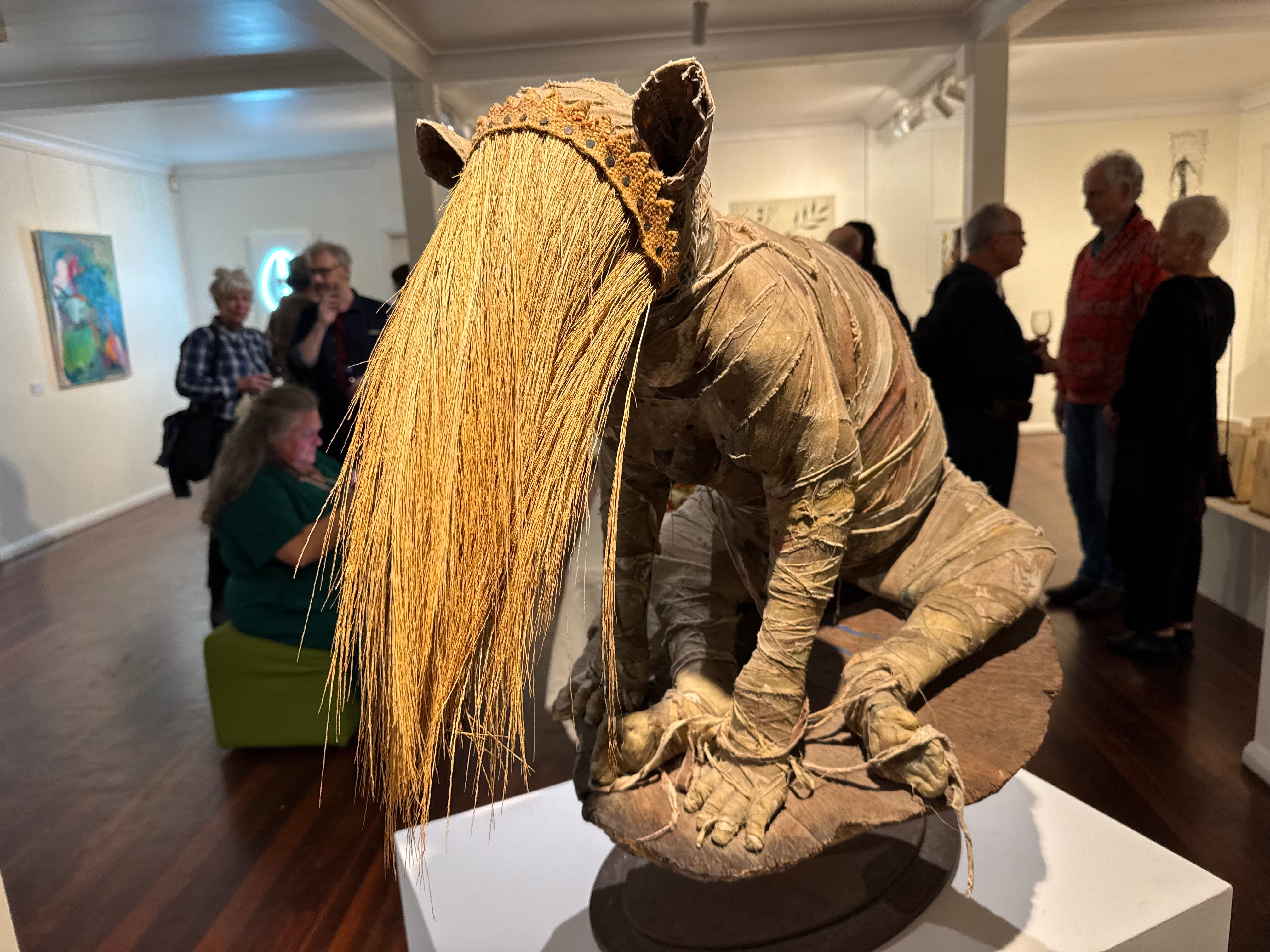
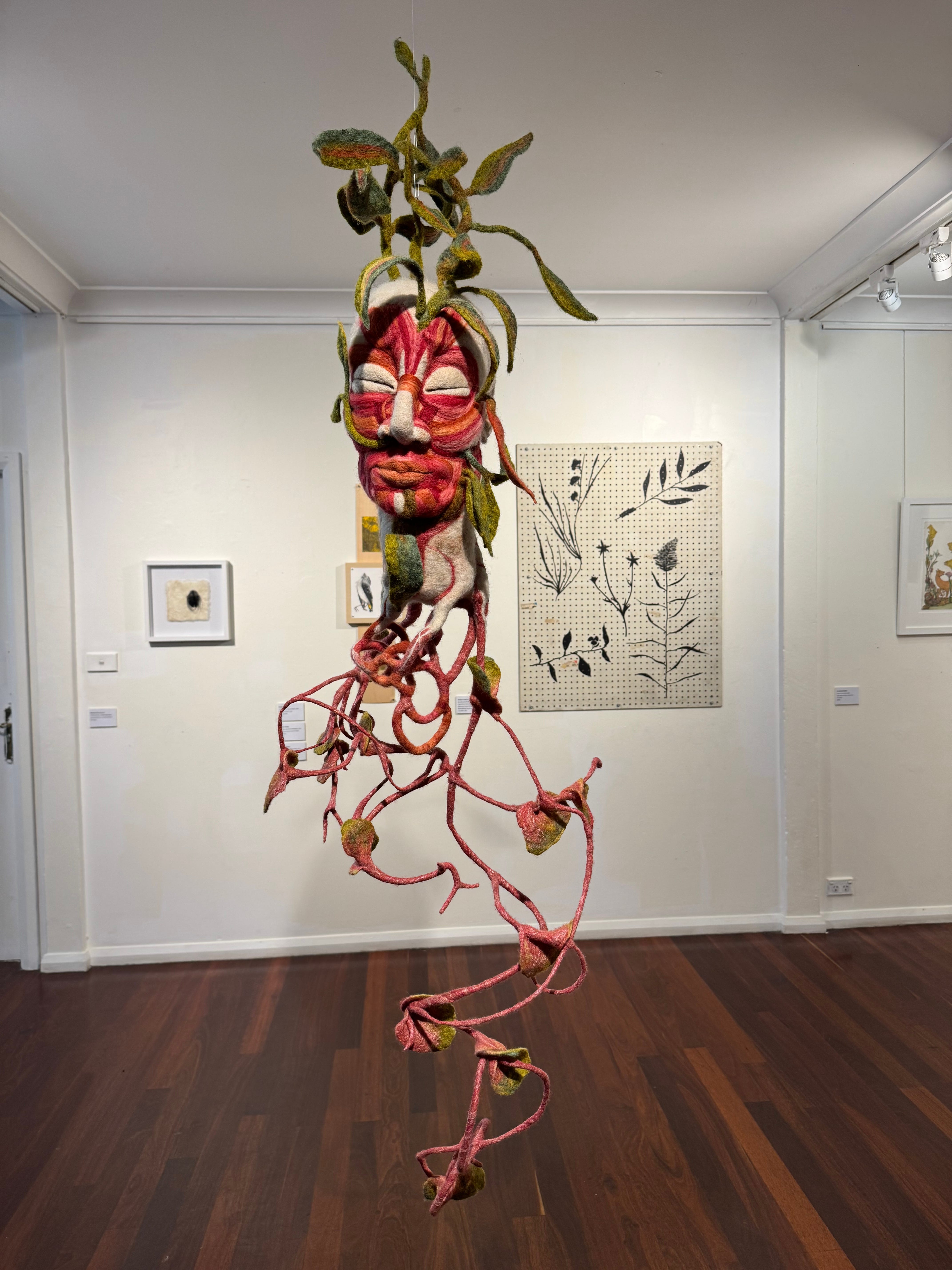
Today, he has a strange sculpture made of wood, stone and found objects standing on a white plinth at the ‘Addi Road Artists’ exhibition inside the Stirrup Gallery at the community centre in Sydney’s Marrickville. It looks like a mythical beast, its broom-fringed face and muscular, compact body a little devilish. Adam calls it ‘Precipice’.
He speaks of wanting to create forms and scenarios that short-circuit the logical. Overall, his sculptures do appear to be repeatedly concerned with nature in trouble – or nature in revolt against us. The beautiful and the unfriendly, emerging on a psychic level rather than any overt eco-message or representational slogan.
It’s one of life’s ironies that Adam has found himself with serious blood problems of his own these the last few years. His body overproducing red cells to the point where he must use blood-thinners after a year of being bled on a weekly basis to reduce the thickened tide in his veins. Like the ironbark trees of childhood, Adam must exude the red sap in any way he can.
When you look around the rather plainly named ‘Addi Road Artists’ exhibition, a concern with nature is evident.
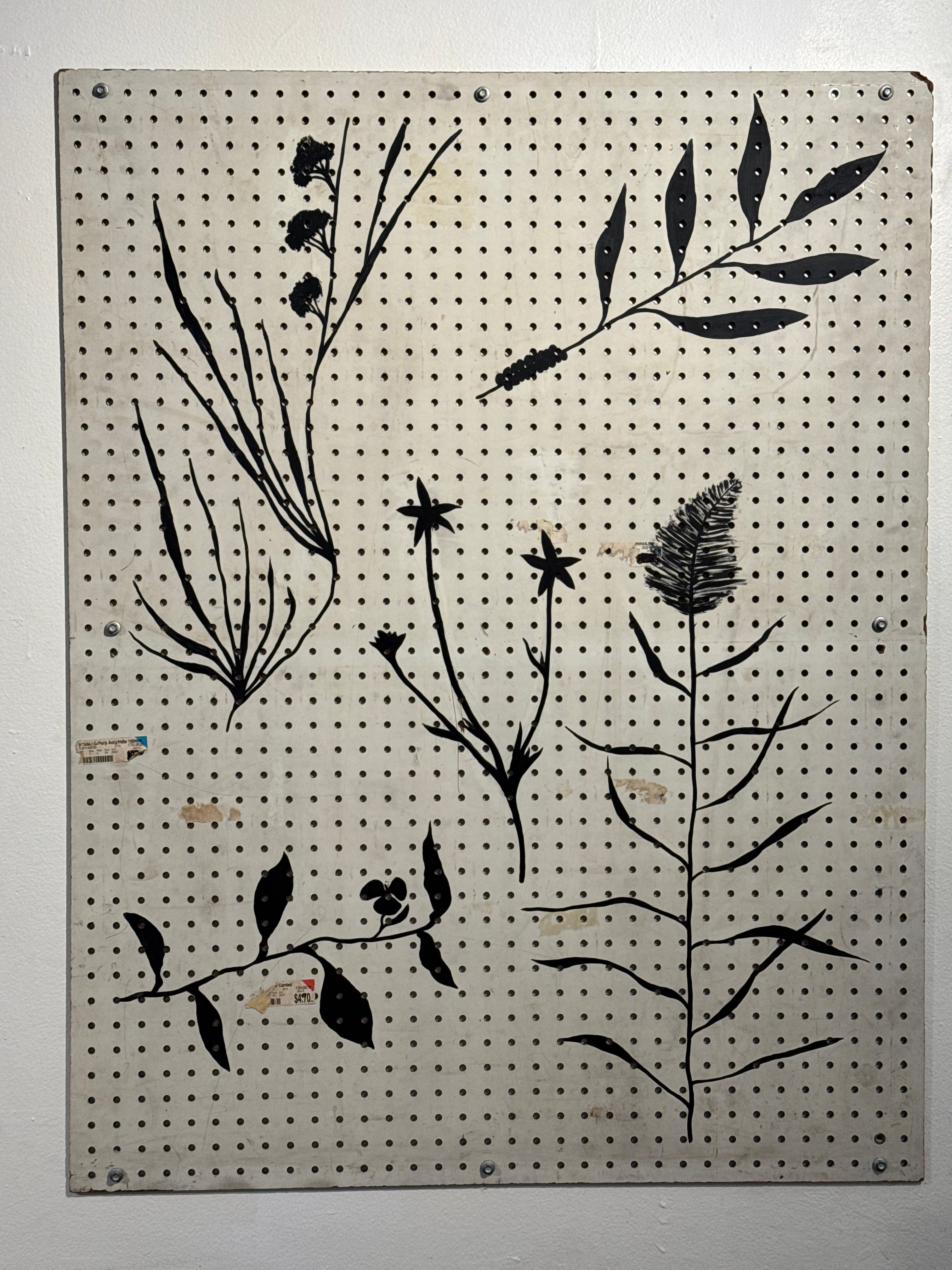
Graham Chalcroft takes on this concern with pictures of native plants shadowed in deep acrylic black on a white pegboard. His work is called ‘Everything Has Its Place!”, commemorating the original Gumbramorra wetlands over which Addison Road Community Centre is now built in Marrickville.
Interested in histories across time – and in nature’s very particular dialogues with a place – Graham’s work is heavily researched, be it for a small piece of art like this, or an architectural design for revisioning an entire public park.
In creating ‘Everything Has Its Place!’, he researched the native plants that were cleared for farmland in the nineteenth century, before the establishment of a military barracks at the start of the twentieth century that next required the wetlands be completely drained and further developed.
He went further into this history, researching the surrounding Marrickville area and how it became a manufacturing hub in the early-to-mid 20th century. So much so, the suburb was promoted in the 1930s as Australia’s ‘Birmingham of the South’.
A hectic semi-industrial and warehouse landscape soon saw the area packed with migrant workers from all over the world. The working-class precursors to a fully-fledged multicultural community that would help bring the Addison Road Community Centre into life in the mid-1970s.
Graham had a vision of the way tools used to be stored in factories, with the black outlines of a hammer or a saw on a hanging board that showed where they should be returned for use the next day. Or exactly what was missing.
He talks about how we live with nature. “We are always taking things out, but we almost never put things back.” This gave him the idea of doing the native plants outlined on his pegboard: things taken away and not returned; shadows that once helped the landscape ‘work’.
This feeling for presences – forsaken and recalled – dominates the ‘Addi Road Artists’ exhibition. Right beside Graham Chalcroft’s artwork are a small set of drawings by Robyn Chiles. An appreciator of her illustrative craft, Graham almost gasps as he points out Robyn’s skills to me. “Her ability to draw is just amazing.” Despite his own large-scale architectural sensibilities, it’s clear he sees himself in more modest conceptual terms when placed beside Robyn Chiles’ microcosmic abilities.
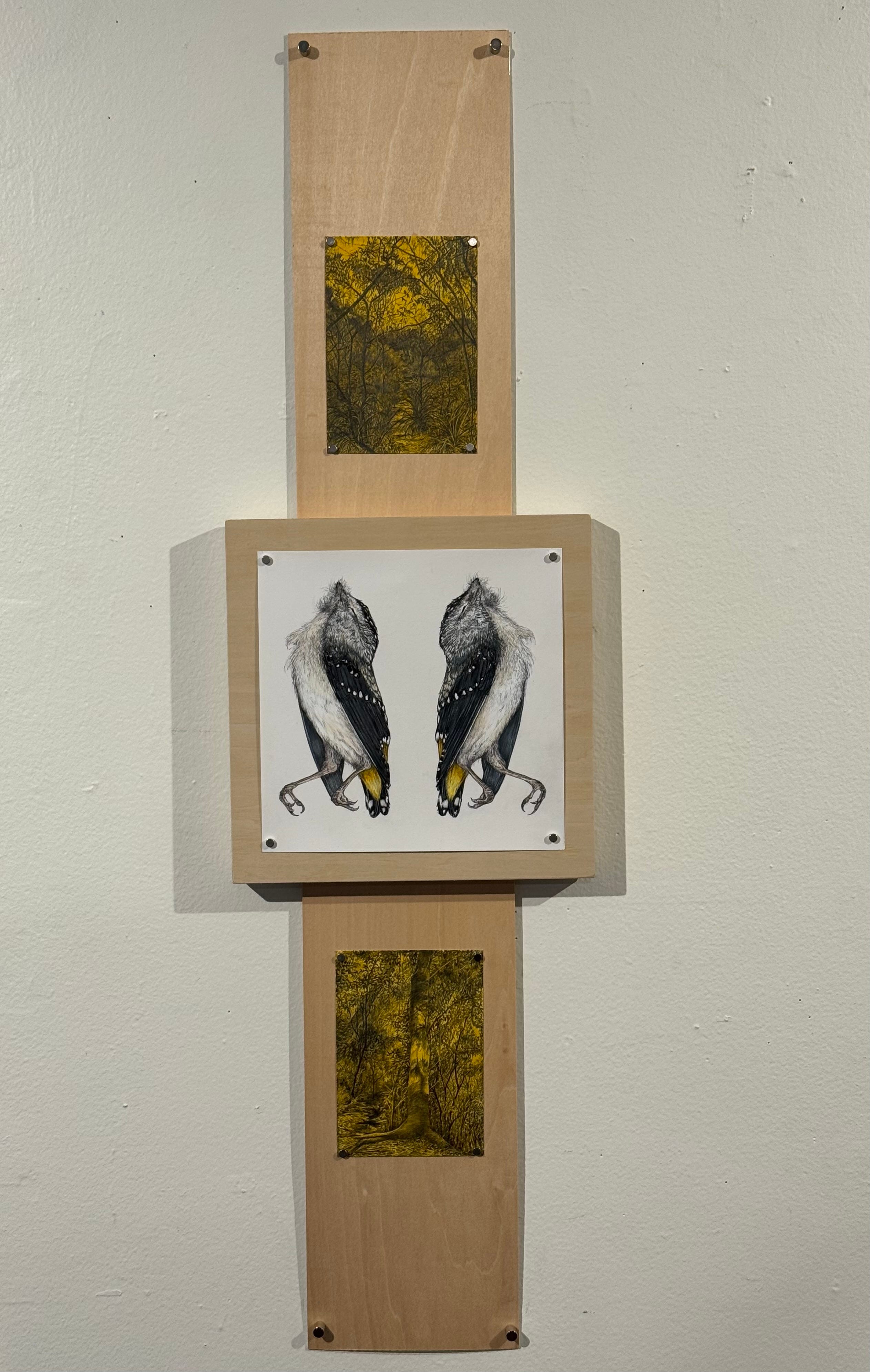
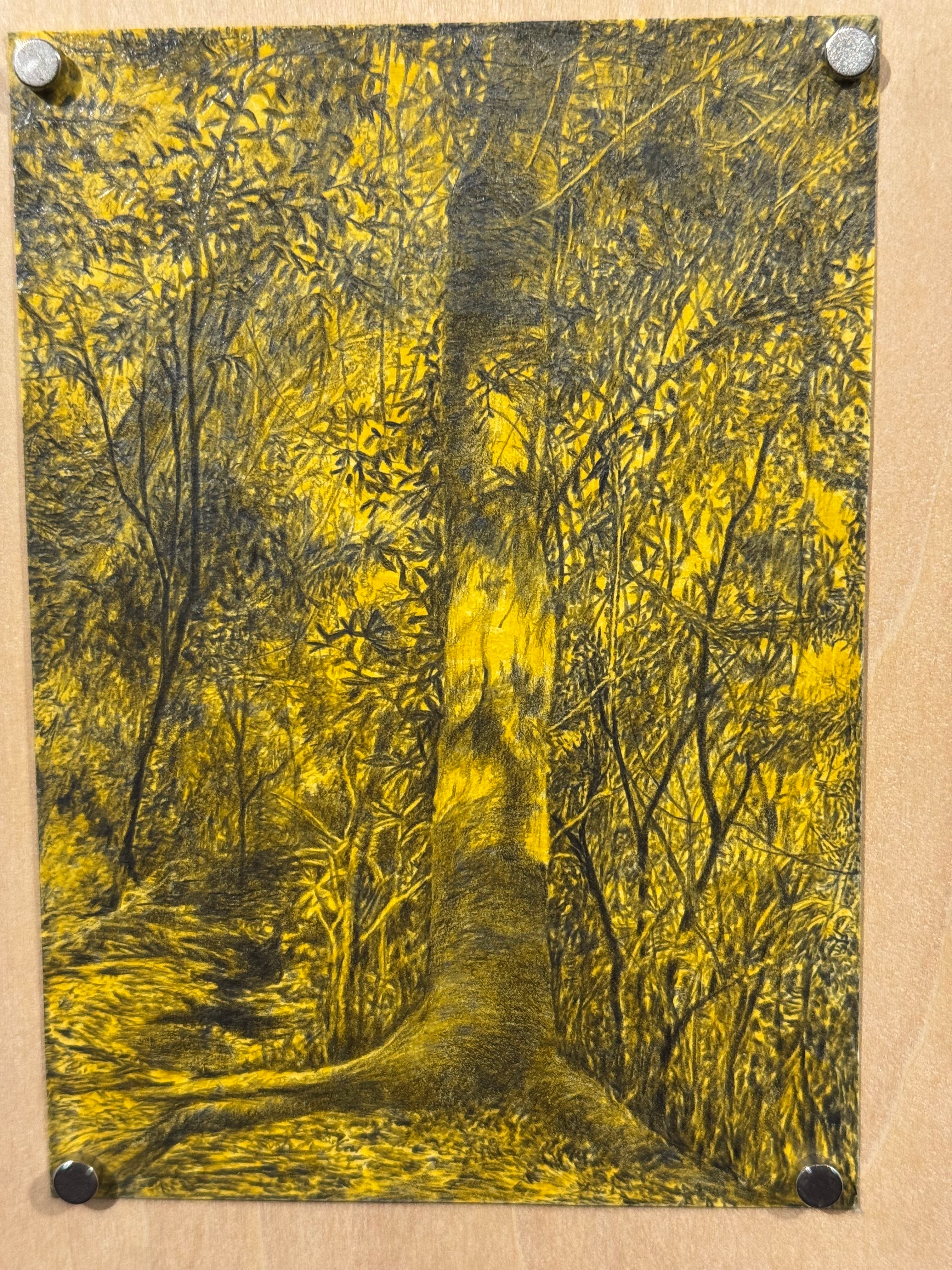
At the centre of her faintly cruciform and interrelated work, Robyn depicts two dead birds poised together in a mutually upwards pose.
“Almost as if they are dancing,” she says.
The detail in them, the ruffled and airy feathers, the hint of death around the beaks, is something to study. Above and below this duo, there are two tiny bush portraits done with graphite on gold paper. Robyn says she wanted those drawings – that seem more like tiny windows – to capture that last light of the day when the sun angles in, a light photographers and artists often call ‘the magic hour’.
She admits the works are about death, most particularly the death of a friend and how it affected her and a small group of intimates who were prevented from contacting them. An uneasy and difficult awareness developed: denial, alienated grieving and shared distance, everyone knowing – at an imposed one-step remove – that someone ‘close’ was passing away.
One morning, a mutual friend went outside and found a dead bird on her kitchen doorstep. “It was weird, like a premonition of what was about to happen,” says Robyn. “All of us unable to make a one last connect. My friend had sent me a photo of the dead bird and I just knew I wanted to draw it. I got her permission. I know it seems like a strange thing to do. I just felt I had to do it and somehow express the feeling.”
Robyn decided to mirror her drawing of that single dead bird into a double portrait, the same bird drawn twice, back-to-back. She then combined this mirror-drawing with two bushland landscapes that were about as large as a polaroid. They frame a tangled, subtle line of perspective, a path inwards for the eye to follow.
Beside this work is one of Barbara Licha’s well-known wire sculptures. Yet another wire cube of hers, inside of which floats yet another wire figure. This time, though, the base metal of her sculptural cage is a coppery golden hue. The figure so black it looks almost cremated. A feeling of being trapped emanates from it, something sad.
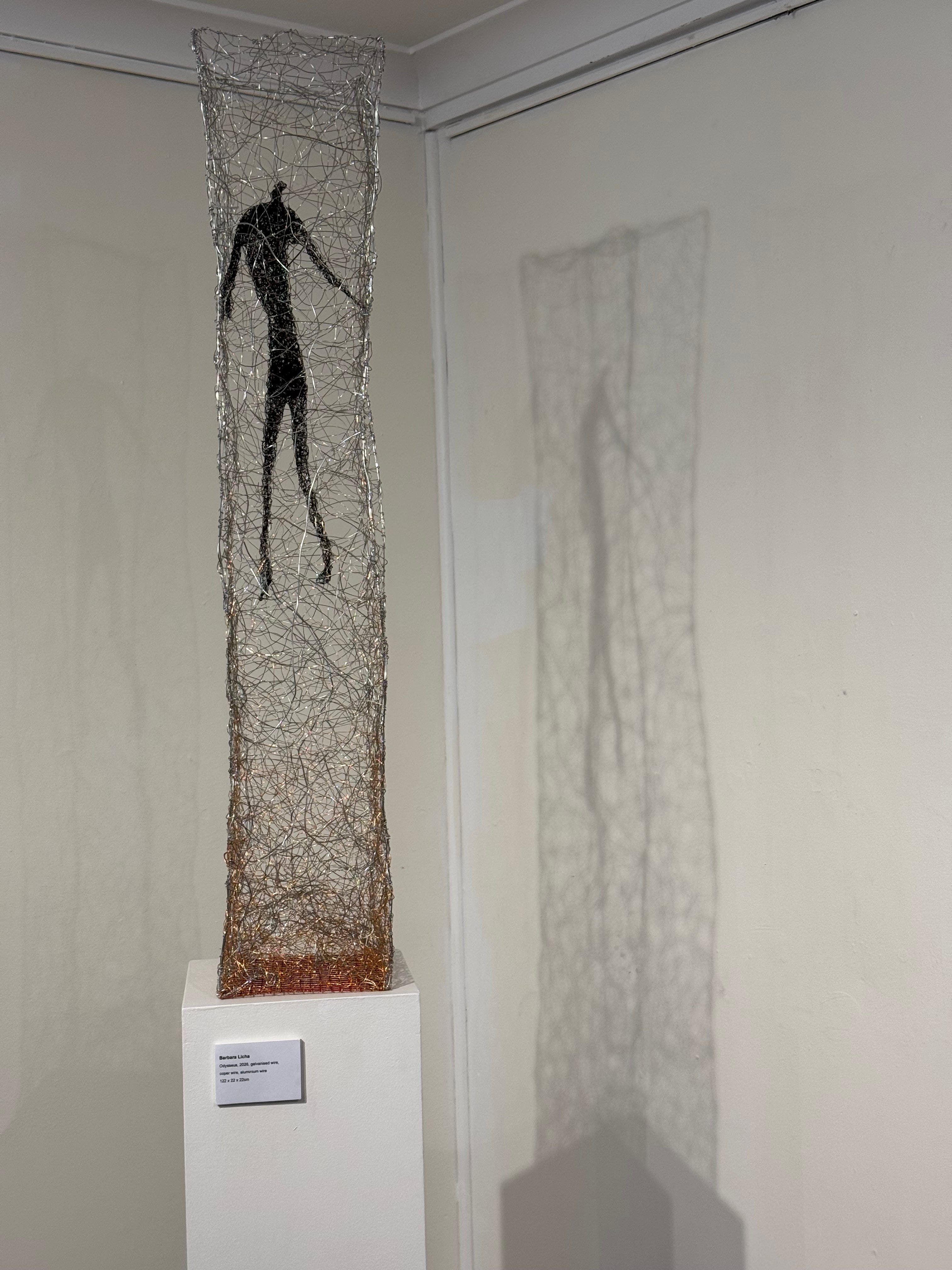
The work is called ‘Odysseus’. “Because Odysseus was always getting into trouble,” Barbara says. “He always trying to find his way home. What is home, where is home, how does he get home?”
She refers then to a local character as another inspiration for the artwork, a person unable to locate themselves in any safe place. A person unable to even locate their own soul in the end. Troubled and seeking, aggressive and confused; shut out from that elusive notion of ‘home’ … home being something to do with a mood in our heads as much as any belonging to a place.
On one level, then, there is the mythical Greek tale behind The Odyssey. On the other, something more abject and local, a conundrum of one person’s mental health that might just as easily translate into a wider narrative for any of us in a city where insecure housing and broken communities leave us uncertain of where we can ever settle. Most especially when we cannot settle into our own nature and being.
Robyn Chiles and Tanya Ljubic are the curators of ‘Addi Road Artists’ at the Stirrup Gallery. All their participating artists have studio spaces inside the community centre. How this pair of curators got over twenty artists into such a coherent show only raises jokey eyebrow, exasperated sighs, one or two curses and the phrase “herding mosquitoes”. And yet Robyn and Tanya have done a remarkable job with gathering the paintings, photos, video works, sculptures and small installations.
Tanya Ljubic looks around the gallery and puts the coherence of the exhibition down to how “mature” the artists all are, most of them mid-career or older, working at a high level of craft and output. Containing such productive forces to just one work was the trick. The best of a single part of them, not all of them, on show.
At the exhibition opening, Tanya gives a great speech where she alludes to the creek that flows underground beneath the community centre, a powerful trace of what was once the Gumbramorra wetlands before it was redeveloped. A trace that rises to the surface, floods the place, and insists on its own path no matter the modern burial it has undergone. It may be a nuisance – the source of all the potholes that keep forming in the carpark – but there is something inspiring about it too, she says. Nature insisting on its own life, appearing and taking over.
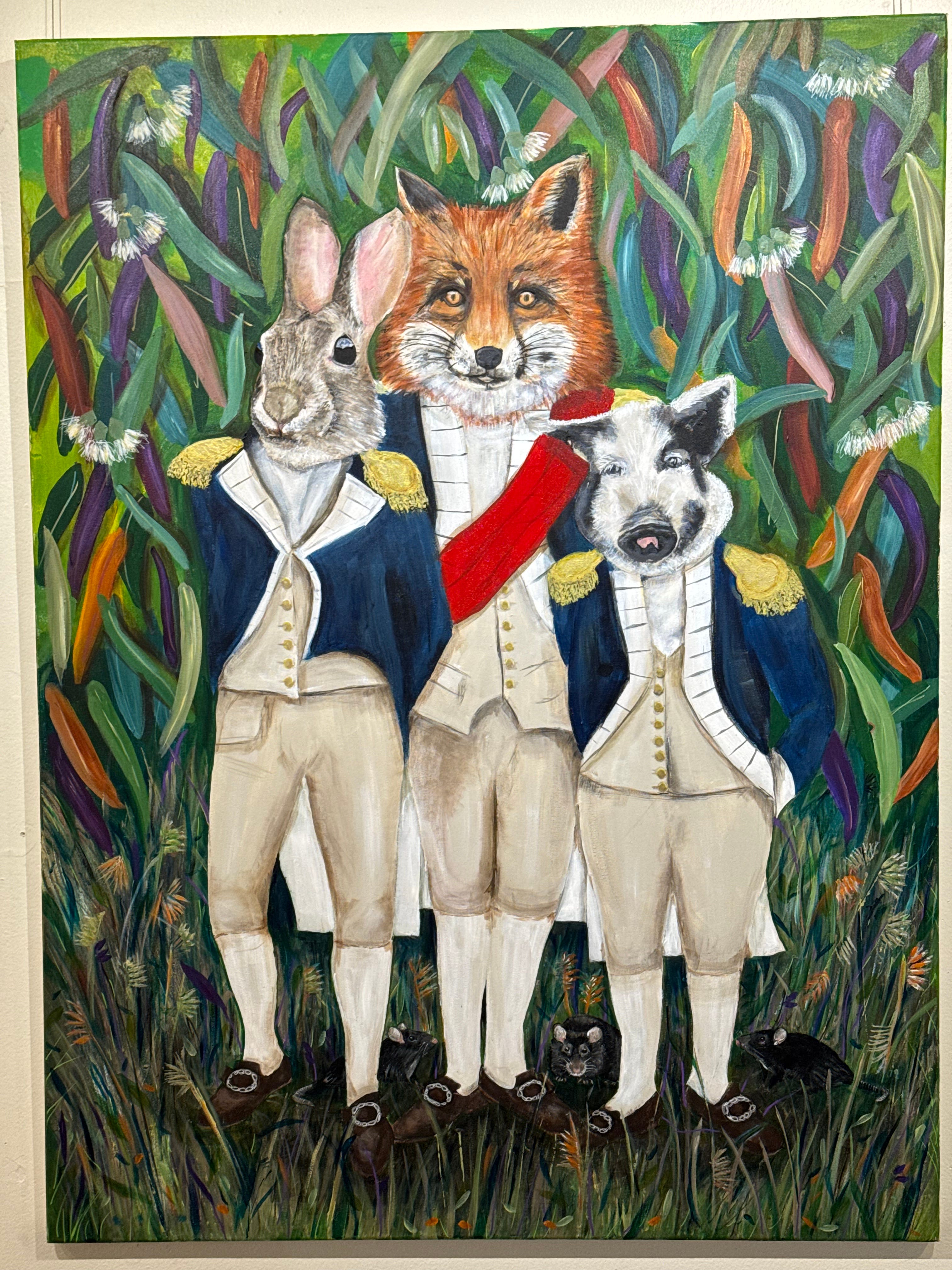
The environmental themes at the exhibition are certainly not singular or puritanically ‘natural’. Much of ‘Addi Road Artists’ concerns itself with the urban world of the inner west and inner city as well. Tanya herself kicks things sideways with satirical energy in a painting of her own, exploring colonisation as a theme with a sly dig via a feral rabbit, fox and pig dressed in uniforms and pantaloons.
Her painting is called ‘Uninvited’.
It’s this seesawing between urban and outback, between history and things half-dreamed, that give the exhibition a surprising unity and quirky dynamic.
As I went to leave, two last conversations somehow wed themselves to all these impressions and my random dialogues with the artists on opening night.
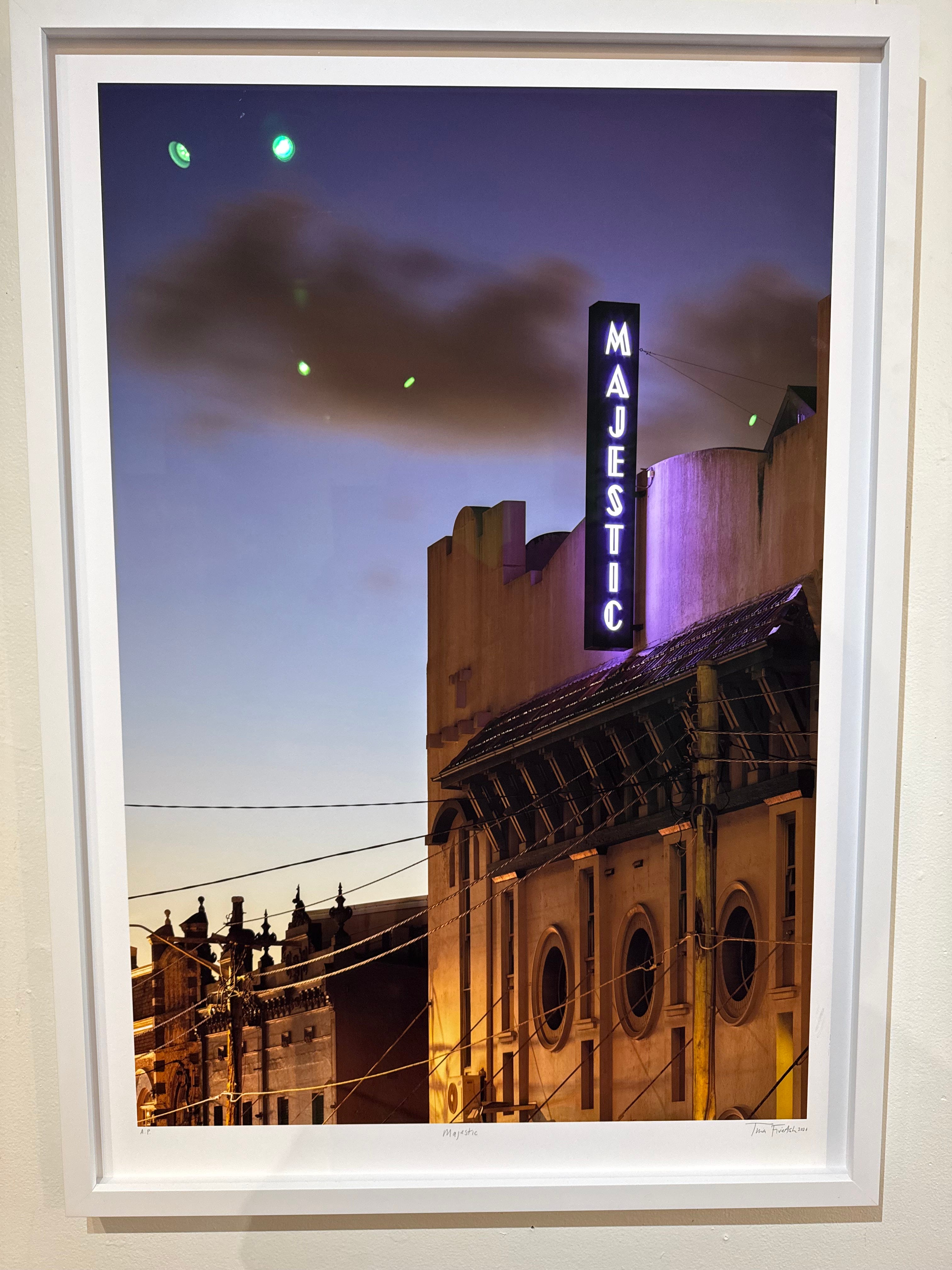
One moment involved looking at a photograph of a building facade with a neon sign that said ‘MAJESTIC’. Either a real – or imagined – hotel or cinema. An archival pigment print on cotton rag, it had the feeling of belonging to a scene from a movie.
Artist Tina FiveAsh tells me she has been obsessed with signs of all kinds and the neon-affected streets of the city. Eventually, she admits to an interest in near-death experiences, a subject she has been studying for the last fifteen years. So much so she has collected almost a hundred handwritten letters from people asking them to respond in their own way to the questions, ‘What is death?’ and ‘What happens when we die?’
It’s something she is still putting together as ‘The Death Letter Project’.
Tina says her obsession with signs and the neon-lit connects to “a liminal feeling for some space between the material and spiritual worlds”. For tonight’s opening, the word MAJESTIC simply drew her to its core shape to then create a photographic work.
“It can mean many things,” she says. “It’s a beautiful word.”
I tell Tina I had assumed it was probably a real hotel, but I was not sure. We get talking about hotels as a metaphoric spaces for dying, the hallways and rooms symbolic of a journey from this life into the next.
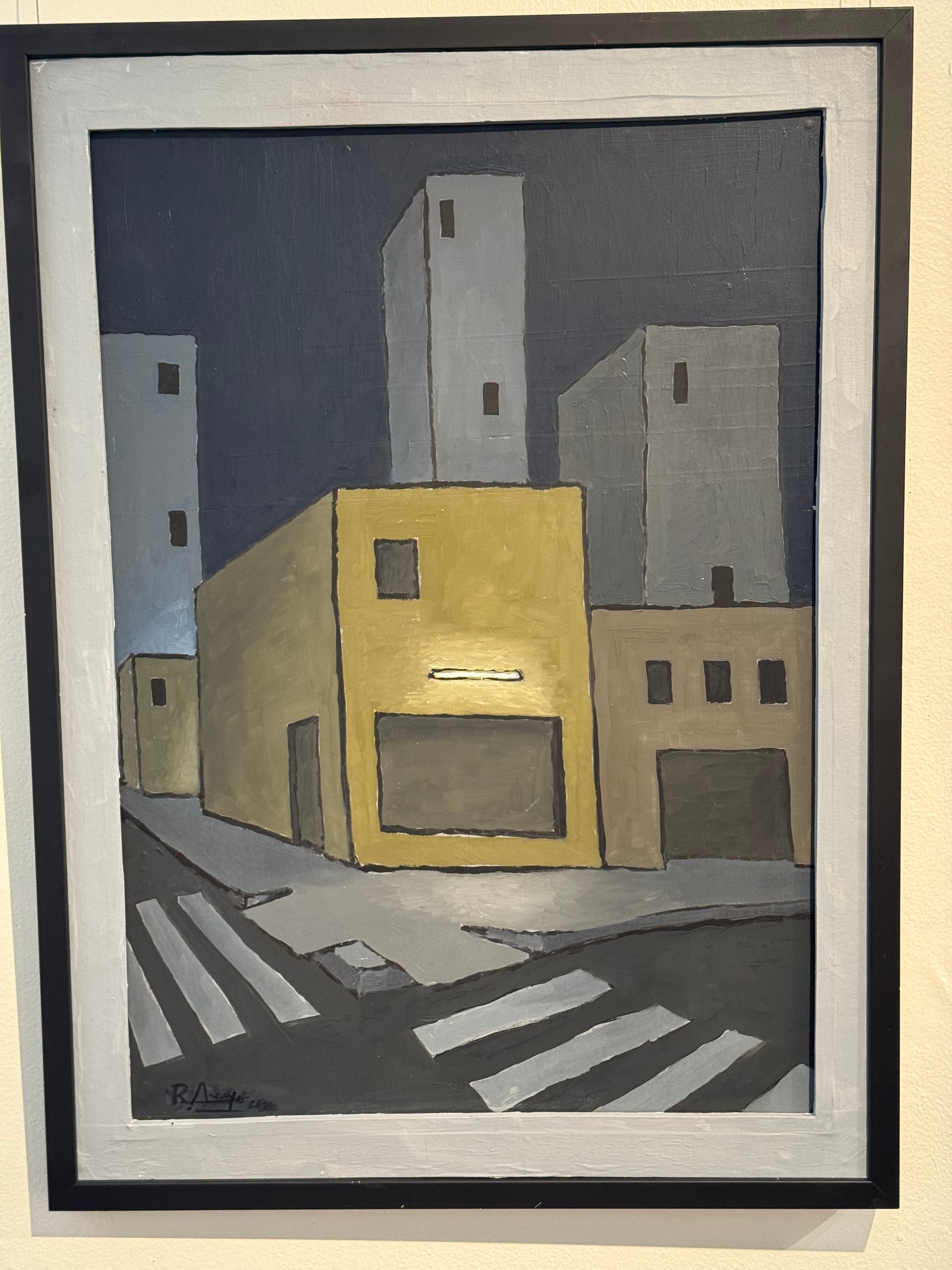
By the gallery doors as I leave, there is a geometric, grey-toned semi-industrial street scene with a warehouse-like building painted a dirty-golden clayish colour. A pedestrian crossing before the building on a crossroads. The picture is devoid of human life. Who knows why such pictures compel your eye, why the bland or cold and oddly familiar attracts. It’s like a street I once walked, a building I once saw. It just reminds me.
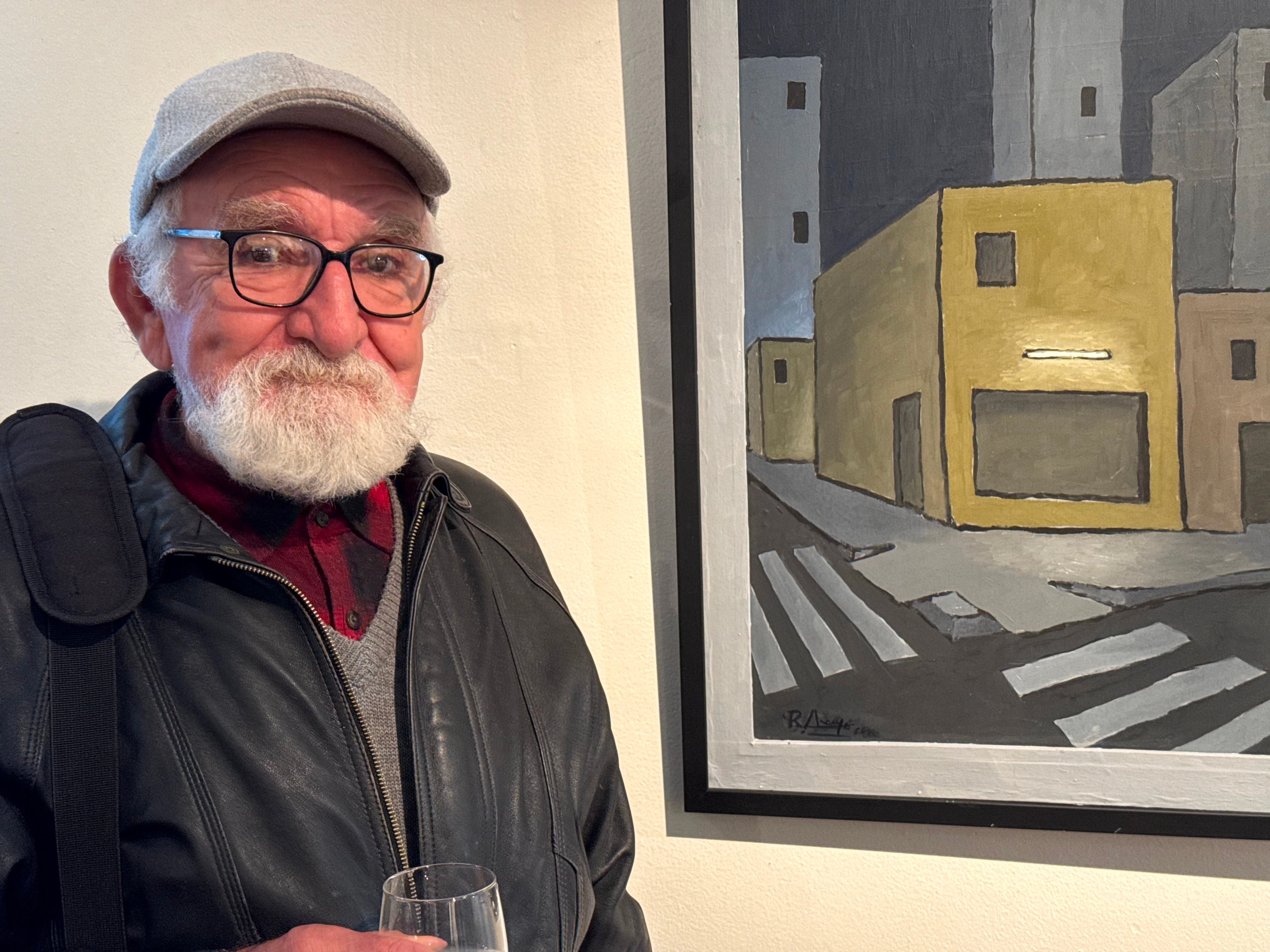
The painter Rodney Araujo Moya is close by. I ask to take a picture of him with his work. It’s difficult to garner much response from him to my questions. I can’t tell if it’s a language issue, the obscuring noise of the crowd at the opening, or, when I notice it, the white hearing-aid in his ear that may not be picking up on what I say.
Rodney looks at my face and finally nods and moves closer to his painting and we take a photo. Then he nods once more and moves away, leaving me to walk from the gallery or into the Twilight Zone spirit of his painting, at least in my mind, on into some street I know but still find strange. Rodney has an unprepossessing title for his picture. It’s called ‘Sydney 3.15am’.
~ M
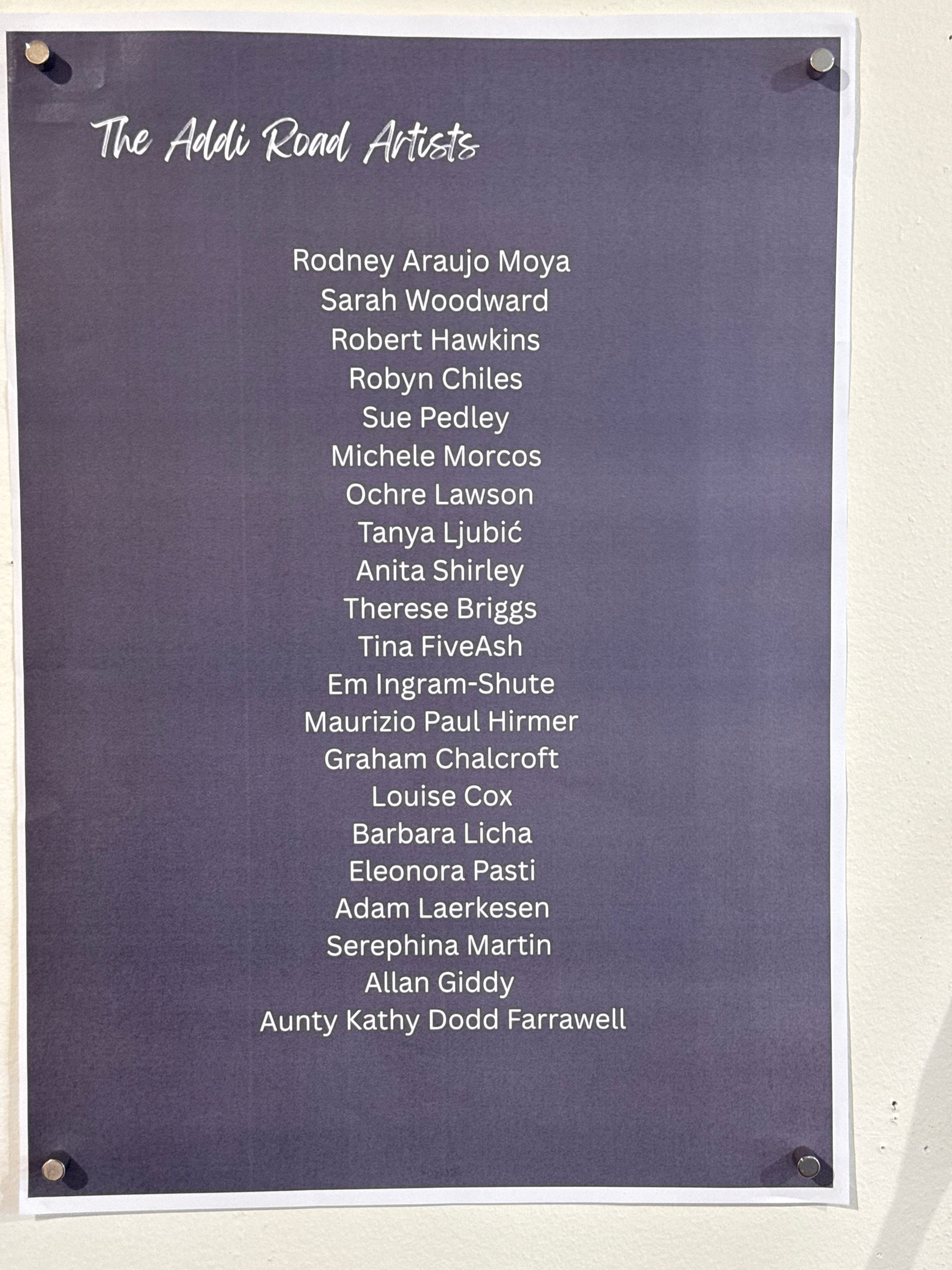
✨ ‘ADDI ROAD ARTISTS’ – GROUP EXHIBITION 📅 14–20 October ⏰ 11am–6pm📍Stirrup Gallery, 142 Addison Rd, Marrickville
‘Addi Road Artists’ takes place as part of the Addi Road Fiesta on Saturday 17 October, a celebration marking the community centre’s 50th anniversary in Sydney’s inner west.
Addi Road operates the Stirrup Gallery as an affordable and accessible community gallery. Most especially to support and encourage artist-controlled exhibitions.

The Addi Road Fiesta program
We’re excited to share with you the program for our 50th Anniversary Celebration on Saturday 17 October, 10.30am to 2pm. Choose your own adventure, and help us celebrate 50 years of community impact.
Trees of life
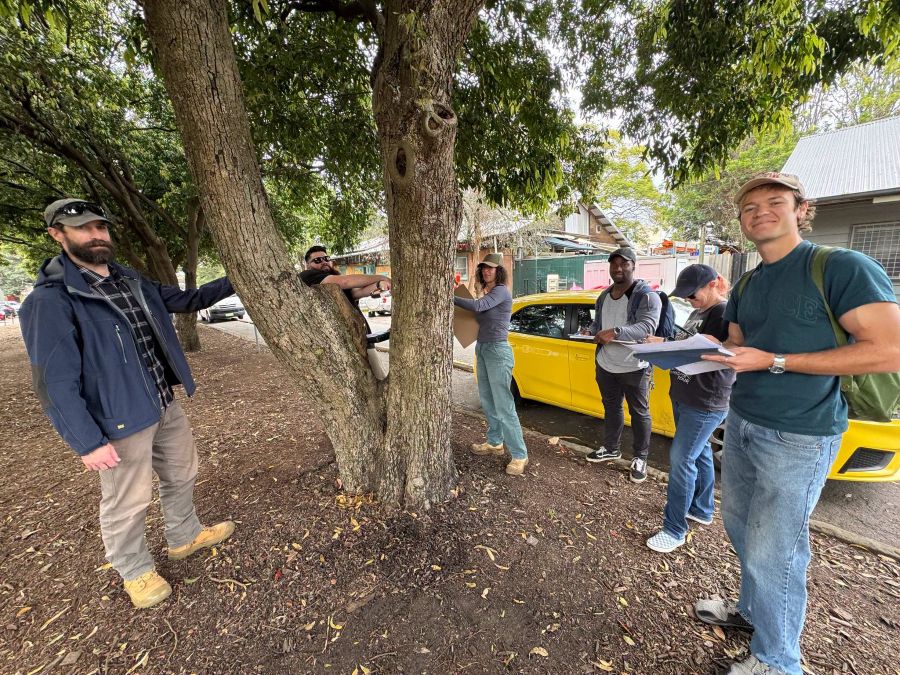
Can you remember a tree you used to climb as a kid? If you head back home, wherever that may be, do you still go to pay that tree a visit if you can?
Nick has a tree like that in his mind.
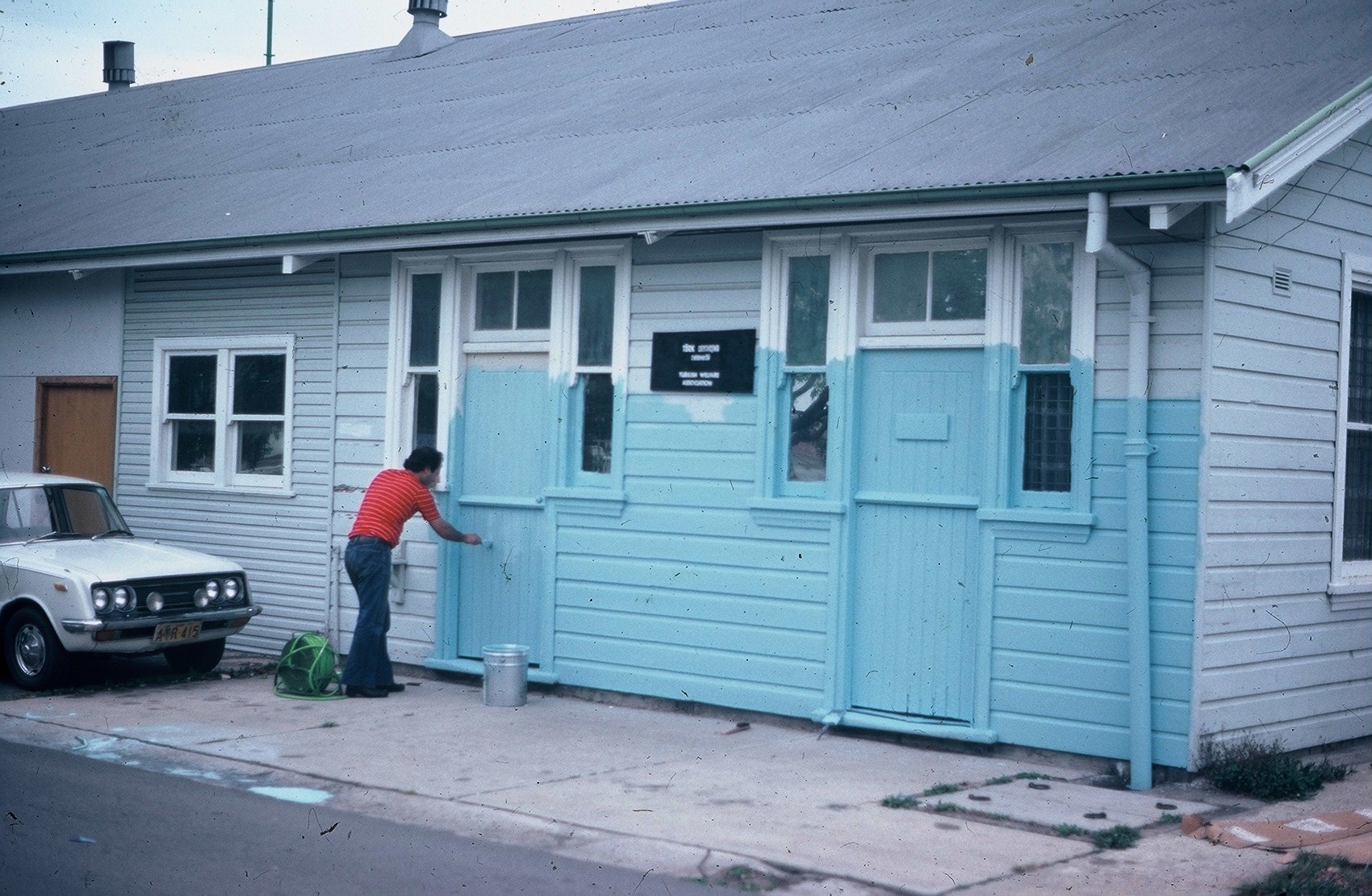
Half a century at the old army barracks
Addison Road Community Organisation (‘Addi Road’) is celebrating its 50th birthday this year in Sydney’s Marrickville. Here, we reflect on five decades of service to the Inner West and beyond.